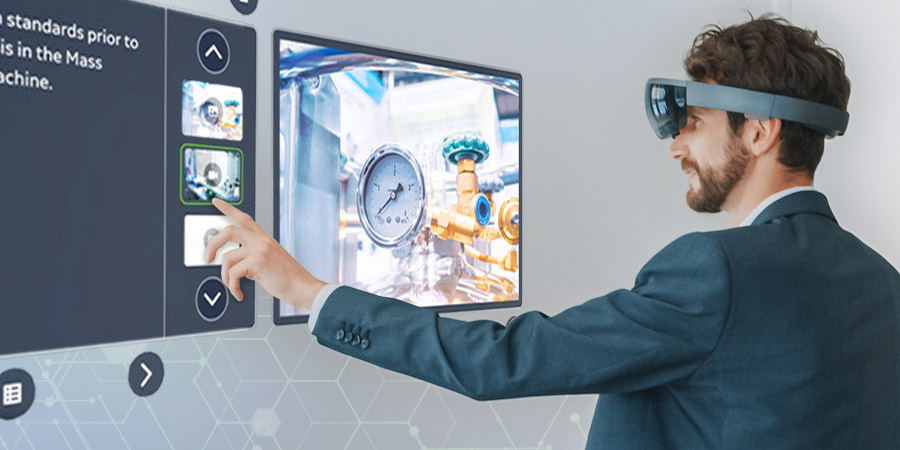
From factory floors to remote boardrooms, augmented reality (AR) is becoming a critical tool in reshaping how work gets done. No longer confined to entertainment or gaming, AR is carving out a powerful niche in enterprise environments.
In manufacturing and logistics, AR headsets like Microsoft HoloLens provide workers with real-time data overlays, hands-free instructions, and immediate error correction—cutting training time and increasing efficiency.
Remote collaboration has also taken a leap forward. With AR platforms, professionals can share a common workspace virtually, marking up 3D models or guiding repairs as though they’re physically present. This reduces travel costs and accelerates decision-making.
For training and onboarding, AR simulations offer realistic, interactive experiences without the risks of live environments. New employees can practice safety procedures or operate complex machinery through guided visualizations before ever touching the equipment.
While adoption still faces hurdles—such as hardware costs, integration complexity, and privacy concerns—experts agree that AR's benefits outweigh the friction. As interfaces become more intuitive and devices more affordable, AR is expected to become as commonplace in the workplace as video calls are today.
Integrating AR isn't just about gadgets. It's about reimagining workflows for a digitally augmented future—where human potential is enhanced, not replaced.
Healthcare is another industry seeing early success with AR. Surgeons are now using AR overlays during operations to view critical patient data or visualize anatomy in 3D, which helps improve precision and reduces the risk of error in high-stakes procedures.
In architecture and construction, AR enables real-time visualization of building plans on-site. Teams can detect misalignments early, reduce reliance on printed blueprints, and improve coordination between engineers, contractors, and clients.
Customer support is also evolving with AR. Companies are deploying AR-assisted guidance to help customers troubleshoot products in real-time, reducing the need for in-person technician visits and streamlining the support experience.
As AR tools become increasingly integrated with artificial intelligence, the next frontier lies in adaptive AR systems—tools that respond dynamically to user behavior and context, enhancing performance and learning without disrupting the task at hand.
Designing virtual reality (VR) environments with the assistance of artificial intelligence is transforming how immersive experiences are conceptualized and built. Traditionally, VR development required extensive manual input from developers and designers, but AI is now streamlining content creation through procedural generation, intelligent asset placement, and behavioral simulation.
One of the most promising uses of AI in VR design is the generation of dynamic environments. With machine learning algorithms trained on thousands of real-world layouts, AI can craft believable, responsive spaces that adapt to user actions in real-time—enhancing immersion and interaction quality without bloating development costs.
Character behavior and interaction logic in VR worlds also benefit significantly from AI. Instead of scripting every possible response manually, AI-driven NPCs (non-player characters) can respond naturally to a user’s voice, gestures, and decisions, creating a more organic and lifelike experience that better mimics real-world social interaction.
Personalization is another major advantage of AI in VR. Systems can learn user preferences over time, tailoring content to suit different learning styles, gaming habits, or therapeutic needs. This flexibility is especially useful in fields like education and mental health, where user engagement and comfort are critical to success.
AI can also assist in testing and optimizing VR environments. Simulated users powered by AI can traverse a VR space millions of times, helping designers identify weak spots, awkward interfaces, or unrealistic physics without relying solely on human testers—saving both time and money.
Voice recognition and natural language processing, powered by AI, further deepen the sense of presence in VR. Users can issue commands, ask questions, or engage in conversations in natural language, making the experience more intuitive and accessible for people unfamiliar with traditional gaming or computing interfaces.
Moreover, AI is helping VR experiences become more inclusive. Tools that translate speech to text, generate sign language avatars, or adjust difficulty based on physical limitations are helping break down barriers and open VR to wider audiences.
As VR and AI technologies continue to converge, the boundaries between digital and physical reality will blur. The goal is no longer just to replicate the real world, but to create intelligent, adaptive environments that expand what’s possible—fostering creativity, collaboration, and deeper human connection in ways we’re only beginning to explore.